


Growing Conversations: Building Singapore’s next wave of innovation growth


Growing Conversations – this is a series where we peel back the layers, sharing how Enterprise Singapore is innovating, disrupting and transforming from within to champion growth for our local businesses, and across industries. Read on to discover how we journey alongside them, wherever they are growing.
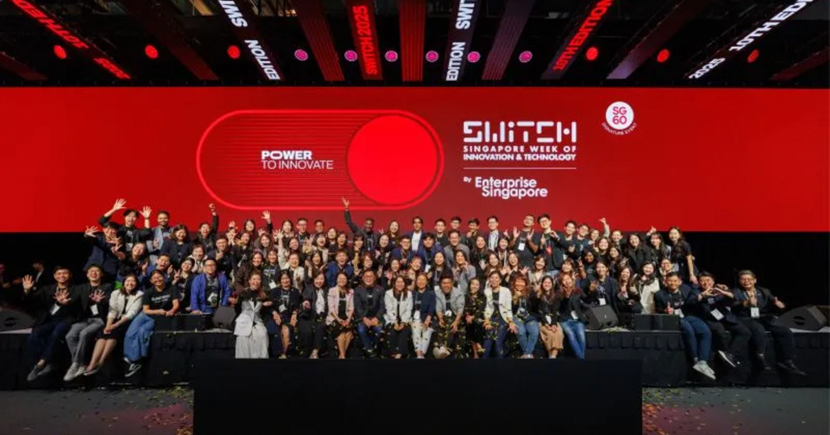
A decade ago, Singapore’s innovation efforts focused on building a vibrant startup ecosystem. Today, as more promising companies emerge, the challenge has shifted to developing the next generation of deep tech startups and helping them turn differentiated technologies into products and global growth.
This calls for more specialised support — from building capabilities in emerging areas to ensuring companies have the capital, resources and market access needed to commercialise their innovations and scale.
As the ecosystem has matured, so has Enterprise Singapore’s Innovation Group. Beyond initiatives such as the Singapore Week of Innovation and Technology (SWITCH), SLINGSHOT and the Global Innovation Alliance (GIA), the team works across the innovation journey, from enabling partnerships to connecting companies with overseas markets.
They share how Singapore’s innovation landscape is changing, and what it takes to move ideas from the lab into real-world impact.

Singapore’s startup ecosystem has matured. How has Enterprise Singapore’s approach evolved with it?
In the early days, the focus was on building the ecosystem and encouraging entrepreneurship. Today, attention is increasingly shifting towards supporting promising companies to fast-track the commercialisation of their innovations, compete globally and create long-term economic value.
Deep tech is one area where we see significant potential. Companies developing proprietary technologies that are difficult to replicate can create significant economic value and potentially become new growth engines for Singapore. We are therefore developing clusters in areas such as quantum, robotics and advanced materials, bringing together the specialised research, talent, capital, industry partners and startups needed for innovation to take root and scale.
While many of Singapore’s deep tech startups are still relatively early in their growth journeys, we are beginning to see promising companies progress and attract meaningful private capital. Companies such as Aprisium and Amperesand have progressed to Series A funding, signalling growing investor confidence in Singapore-based deep tech companies as they move towards commercial scale.
At the same time, as more deep tech startups progress beyond their early stages, their needs are evolving. Beyond initial funding, they require growth capital, experienced investors, strategic partners and international networks. For example, Startup SG Equity has been expanded through a S$1 billion top-up to support growth-stage deep tech startups as well.
How do the different teams within Innovation Group work together across a company’s growth journey?
We see innovation as a continuum — from ideation and discovery and proof-of-concept, to market validation and commercialisation. The stages are not always linear, and each team may contribute at several points.
Broadly, Startup Ecosystem Development creates the conditions for startups to emerge by nurturing founders through connecting them to demand, capital and talent and strengthening the startup ecosystem. Innovation Ecosystem Development develops strategies, policies and schemes to deepen the innovation capacity of companies. Global Innovation Network helps companies access overseas partners, networks and market opportunities to pursue cross-border innovation and expand overseas.
Together, we help companies turn ideas into viable businesses and sources of growth.
Deep tech is a growing priority. What does it take to build a strong ecosystem around it?
Building a strong deep tech ecosystem requires several pieces to come together — technology, talent and commercialisation capabilities, patient capital, and pathways to customers and markets. Our role is to strengthen these building blocks in areas where Singapore can develop differentiated capabilities and capture emerging opportunities, such as quantum, robotics, advanced materials, carbon capture and semiconductors.
Talent and commercialisation capabilities are critical. Deep tech founders need to navigate both technical and commercial risks in bringing technologies from lab to market. We work with universities, research institutions and experienced global partners to build these capabilities. For example, we partnered Engine Ventures, which invests in “tough tech” founders, to run its Pathways Workshop in Singapore, equipping researchers and scientists to assess trade-offs, prioritise risks and turn breakthrough technologies into investable ventures.
Patient capital is another important enabler. Deep tech companies often have longer development timelines and higher capital requirements. Through Startup SG Equity, we co-invest alongside private-sector investors in promising Singapore-based deep tech startups, helping to crowd in private capital and support companies through their commercialisation journey.
We also work with specialised investors and venture builders that can evaluate technologies, help build founding teams and spin out intellectual property from our research institutions, while connecting startups to capital, industry partners and customers.
Ultimately, no deep tech company scales alone. A strong ecosystem comes from connecting researchers, founders, investors, venture builders, corporates and the public sector so that promising technologies can move from the lab to market — and ultimately build globally competitive companies from Singapore.
Where does open innovation fit in?
Open innovation connects technology development with real demand. It provides a platform for SMEs and startups to tackle real-world challenges and test their solutions in live environments, helping them unlock new business lines and build up a credible track record. For corporates, it offers an opportunity to co-develop solutions alongside emerging innovators in an agile manner to augment their internal R&D.
Open innovation is not one-size-fits-all. Different objectives call for different modalities, each designed to address a distinct need. Some challenges focus on advancing the development of new, cross-cutting capabilities, such as in sustainability and AI where emerging technologies have the potential to transform industries broadly.
Others target specific industries where there is appetite for innovation, whether that means driving the development of new technologies in growing sectors like foodtech, or accelerating adoption in more established ones like aerospace and retail.
Challenges can also be oriented around market access, connecting Singapore-based companies with real demand in overseas markets like Europe.
Once companies have validated their solutions, how do you help them expand overseas?
Through GIA, we connect Singapore startups to partners in key innovation hubs around the world, helping them access customers, investors, corporates and innovation partners as they expand overseas.
The support is tailored to where each company is in its journey. Companies that are newer to a market can tap market insights, in-market discovery and acceleration programmes to understand local demand and sharpen their go-to-market approach. Those ready to scale can access specialised ecosystem partners, corporate pilots and testbeds, as well as cross-border R&D opportunities.
Importantly, the journey need not be sequential. We meet companies where they are and connect them to the opportunities most relevant to their growth. Increasingly, we are also moving beyond one-off programmes towards sustained networks that can continue creating value for companies like Aliena as they scale internationally.
These efforts can take time. What does progress and eventual success look like?
As our focus expands towards commercialisation and scale, it’s important to recognise that outcomes are not always immediate or linear.
R&D projects may take two to three years to produce meaningful outcomes, while market-access programmes can show results within 12 to 18 months.
In open innovation, for example, a successful match between a corporate and solution provider is only the beginning. The journey from an initial problem statement to real-world adoption can involve product development, testing, training and pilots before a solution is ready for deployment and commercialisation.
One example is Unravel Carbon, a Singapore-based company whose AI-powered decarbonisation platform helps businesses track, reduce and report their carbon emissions. Through the Nordic Open Innovation Project, Unravel Carbon worked with ABB, a Swedish technology leader in electrification and automation, to automate lifecycle assessment calculations across ABB's motor product families.
Unravel Carbon deployed its AI-driven product carbon footprint platform across ABB's manufacturing sites in Finland, China and India, enabling product designers to compare environmental impacts across different motor variations. Following the project's completion in March 2026, both parties are exploring a strategic partnership to extend these capabilities across a broader range of motor families.
How are platforms such as SWITCH and SLINGSHOT evolving to support these ambitions?
As Singapore’s innovation ecosystem matures, the value of platforms like SWITCH lies in turning the right connections into tangible outcomes — new partnerships, investments, pilots and pathways into regional and global markets.
We are therefore evolving SWITCH from an annual convening platform into a catalyst for purposeful connections and deal-making. Its content, curated networking and side events are designed not just to spark conversations, but to help founders, investors, corporates and ecosystem partners identify shared opportunities and move towards concrete collaboration.
Now in its tenth year, SLINGSHOT is SWITCH’s global deep tech pitching competition and an important gateway into Singapore’s innovation ecosystem. It brings high-potential startups to Singapore to showcase their technologies, connect with investors and industry partners, and explore opportunities to build a lasting presence here — strengthening the pipeline of globally competitive companies that can grow from Singapore.

Innovation is rarely straightforward. What helps the team keep learning and moving forward?
A genuine interest in innovation and technology. Innovation moves quickly, so we are always learning from founders, startups, scientists and investors.
We also have the freedom to experiment, try new ideas, learn from what does not work and adapt along the way. For example, the Breakthrough Energy Fellows – Southeast Asia programme began as a pilot in 2024, becoming the first Fellows hub outside the US. Since then, the inaugural cohort has made progress towards commercialisation, with CRecTech turning its sustainable marine fuel solution into commercial contracts.
Beyond work, we enjoy exploring new food spots around the office or joining interest groups (like spin!) together. These moments help us bond and build the trust and camaraderie that make working together enjoyable!
Come see innovation in action at SWITCH 2026, from 27 to 29 October.
Read more Growing Conversations