


: Singapore's agri-tech firms find fertile ground


First published 06 Nov 2025
From prawn disease detection to drone pollination, home-grown start-ups are exporting innovations, helping farmers and strengthening food security across Asia and beyond
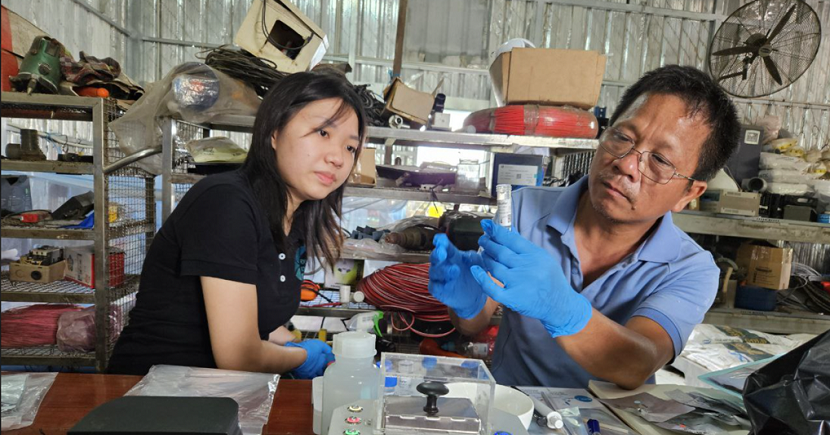
It is an unlikely sight in a Singapore industrial estate: tubs of prawns stacked inside an office in a 10-storey concrete building. But these prawns are not bound for the wet market.
They are part of a research facility run by home-grown start-up Forte Biotech, which is leveraging medical science to create tools that help shrimp farmers many kilometres away.
The firm has repurposed polymerase chain reaction (PCR) technology – the same one used in Covid-19 testing – into a portable test kit for shrimp diseases. Called Rapid (short for Really Accurate Prawn Infection Detector), the kit delivers results in under an hour with about 92 per cent accuracy in concurrence with qPCR lab results, the standard lab test used to identify infections.
Forte Biotech’s co-founder Kit Yong says disease is one of the biggest threats farmers face. At US$500 (about $646) for a basic model – market options typically cost more than US$5,000 each – the device is priced to be accessible to even smallholder farmers, who run modest operations. Crucially, Rapid can be used by non-technical workers too.
Less than five years after its founding, Forte Biotech has 95 customers across South-east Asia, with Vietnam, Thailand and Indonesia being its biggest markets.
Its early growth was made possible by Singapore’s support for deep tech start-ups. It received a Proof-of-Value grant under Enterprise Singapore’s (EnterpriseSG) Startup SG Tech scheme, which supports proprietary technology solutions with commercial potential.
With that support, Yong built the firm’s manufacturing capacity, developed a prototype, and tested it successfully with several farms across Vietnam.
The firm also got a boost from the National University of Singapore’s (NUS) Agritech Centre, where it test-bedded its ideas and shared space with other young companies – including a start-up tackling a very different challenge in farming.
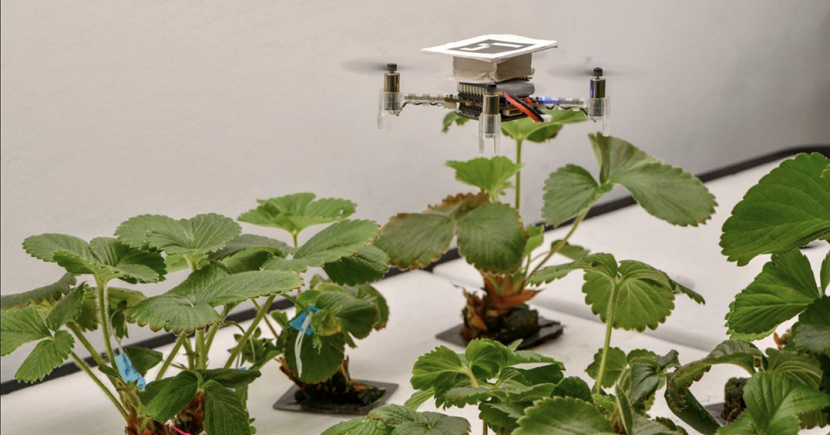
Polybee, a spin-off from NUS, tackles a problem that farmers have traditionally left to nature: pollination. Using micro-drones, computer vision and artificial intelligence, the start-up has built systems to automate pollination in greenhouses.
With bee populations in decline in many regions, BeeOS, the firm’s flagship product, helps ensure consistent pollination, while tracking plant health and predicting crop yields.
Founder and chief executive officer Siddarth Jadhav says: “Polybee is a product of Singapore’s deep tech ecosystem; it has facilitated our journey from idea to revenue.”
With seed funding, government grants and access to testbeds, its drones are now operating in farms from New Zealand to the UK, where they help improve strawberry pollination in greenhouse tunnels with support from a UK-Singapore R&D collaborative grant.
“We are fortunate to be working with Angus Soft Fruits, one of the UK’s biggest berry producing co-operative, and UK Agritech. This grant has significantly de-risked our market entry by allowing us to partner with pioneers in the industry and rigorously testing our product before launching it at scale,” says Siddharth.
The start-up is backed by venture fund elev8, the Singapore Economic Development Board and EnterpriseSG’s Seeds Capital (now SG Growth Capital).
In Singapore, the rise of firms like Forte Biotech and Polybee reflects a broader national effort to harness science and technology to build food resilience amid global warming and disrupted supply chains. Other countries are doing the same.
The Asia-Pacific agri-tech market, valued at US$4.83 billion in 2024, is forecast to reach US$29.87 billion in a decade. Globally, the sector is expected to almost double to US$54.17 billion by 2029.
Yet, Singapore's innovations are uniquely driven by its natural constraints, such as land, water and energy. And that allows the city state to position itself as a regional hub for resilient food solutions as the region faces similar challenges due to climate change, demographic shifts and supply chain vulnerabilities.
Sharon Tay, director of EnterpriseSG’s food manufacturing and agri-tech division, says: “Singapore's strong governance, progressive R&D capabilities and established regional networks position us as an innovation hub driving Asia's transition towards a sustainable and climate-resilient agri-food system.
“EnterpriseSG is fostering collaborations between start-ups, research institutes, industry partners and financing ecosystem players to test, refine and scale innovative solutions regionally.”
Set up by EnterpriseSG in partnership with institutes of higher learning, Centres of Innovation form a key part of Singapore’s ecosystem. An example is the Aquaculture Innovation Centre (AIC), which helps local and regional firms adapt technologies originally developed for human use, from water monitoring to health diagnostics, to work in fish ponds.
In one case, the centre helped develop a water quality sensor diagnostic kit for fish farms in just six months, drawing on its testing facilities and access to farms in Vietnam and Indonesia.
Local upstart, global impact
AIC’s familiarity with the region’s aquaculture ecosystem has also resulted in innovative projects, including a Brunei crab hatchery that also rewards farmers for mangrove protection with blue carbon credits.
Together with the Aquaculture Health Hub and the Urban Agriculture Centre of Innovation, AIC plays a key role in supporting local start-ups to advance product innovations.
Hubs like Vidacity, which offers start-ups targeted programmes and infrastructure access, and innovation labs such as Norway’s Thryve Innovation CoLab also work in tandem with EnterpriseSG. They help start-ups accelerate testing and build capabilities, bridging the gap from scientific research to commercial success.
The agency is helping companies expand abroad too. One such firm is Singapore Agrotechnologies, which focuses on fertilisers and crop nutrition.
Its chief executive officer Adrian Ng says: “Asia is among the most intensive fertiliser users. With new climate-smart fertiliser technologies, there’s immense potential to transform this intensity into productivity, making yields globally competitive while increasing responsiveness to climate stress.”
The company offers products spanning seven categories, from biostimulants and nanotechnologies to soil conditioners and stress protectants that are seeing rising demand as the Asia-Pacific biologicals market grows at a compound annual growth rate of more than 10 per cent towards 2030.
For instance, in Thailand’s Chanthaburi province, durian farmers have used the firm’s root nourishment, stress resilience and photosynthesis-boosting products to improve crop quality and increase production.
Singapore Agrotechnologies also works with research institutions and taps EnterpriseSG’s innovation network, including its Innovation Partner for Impact (IPI) subsidiary, to develop products and expand into new markets.
EnterpriseSG has also helped it navigate international trade processes and supported its overseas expansion under the Market Readiness Assistance Grant.
Such efforts to expand into new markets contribute to the agency’s broader vision of addressing the region’s agriculture needs as Asia’s agri-food innovation hub.
To that end, Polybee’s Siddharth says: “It is phenomenal that start-ups from Singapore have support available in all corners of the world through EnterpriseSG’s regional offices; it is hard to find this sort of global presence anywhere else.”
Behind such success is a broader story: of start-ups helping one another thrive, even as they tackle vastly different farming challenges. This sharing of resources and learnings allows Singapore’s agri-tech ecosystem to provide more comprehensive solutions, with firms collaborating across the region’s entire agricultural value chain.
Agri-fintech firm AgriG8’s co-founder David Chen, who recalls how Forte Biotech connected him to field contacts in Vietnam, quips: “That’s something that’s very, very unique about the Singapore agri-tech ecosystem.”
Start-ups tap talent from polytechnics, universities and across the region, blending technical expertise with local and cultural know-how. The result is a growing network of firms exporting Singapore-built ideas – and feeding a more secure future.
Chen says it best: “There is a really strong kampung spirit that gives us this very competitive advantage in the region.”
Learn about how Enterprise Singapore is growing industries and uncovering new opportunities for home-grown businesses.
Source: The Business Times © SPH Media Limited. Reproduced with permission.
Fintech for farmers
Many smallholder farmers are locked out of formal banking. Without credit histories or reliable records, these farms – typically family-run and working with limited land and resources – are often seen as too risky for loans.
AgriG8, a Singapore-based agri-fintech firm, wants to change that by turning data into something both farmers and banks can use.
Its co-founder David Chen says: “Most of these farmers in South-east Asia are considered unbankable.”
For example, they often need loans to invest in certified seeds but struggle to access credit from the banks.
To address this, AgriG8 developed CropPal, a mobile app that gamifies data collection with a Tamagotchi-style interface. Farmers input simple field updates while satellites track crop health in the background.
The app provides feedback to farmers, but generates credible, data-backed risk profiles that help banks assess creditworthiness. By tying sustainable farming practices to financial access, the app makes green agriculture both practical and profitable.
AgriG8 received two grants from Enterprise Singapore which helped it hire developers who built machine-learning capabilities into the app, and readied it for launch on the Android Play Store. It could then go on to start pilot trials in Cambodia that cover 700ha of rice fields.