


: How Keystone Cable wired up to keep its products ‘Made in Singapore’


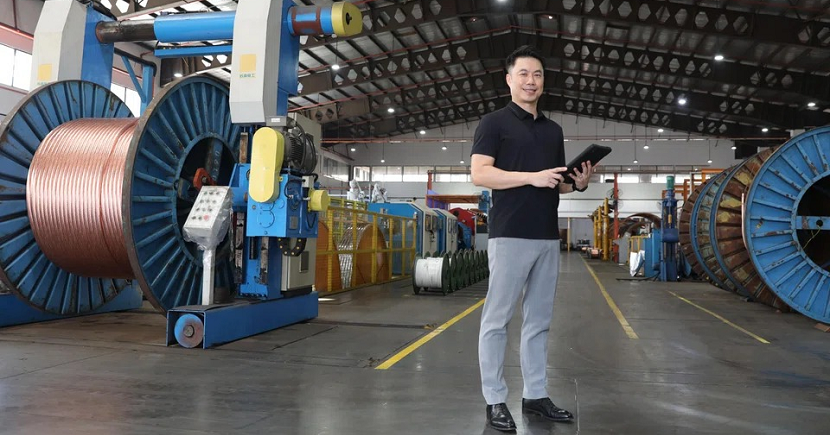
[SINGAPORE] After decades of supplying electrical cables, Keystone Cable took the chance to wire up its own operations – for a data-driven factory floor – when it moved to a larger site.
Founded in 1990, the cable manufacturer found itself outgrowing its premises by the mid-2010s.
“Space was limited, and machines were placed wherever there was room, with little regard for process flow,” recalled Derek Zhu, one of Keystone’s three directors who oversees operations and finance.
The inefficient layout meant precious time was wasted as products moved between production stages. The company’s administrative processes were also lagging, being largely paper-based and manual.
“Our staff spent a lot of time on administrative tasks. We wanted to digitise and automate these processes,” said Zhu.
The company found a new factory along Senoko Drive that was three times larger than the original, and reinvented its processes not just for the new space, but the future.
The drive for efficiency spurred Keystone to join Enterprise Singapore’s (EnterpriseSG) Scale-Up programme in 2020 – the same year it moved into its new home.
The programme supports local companies with high growth potential and ambitions to scale rapidly and effectively.
Over 12 months, participating companies work with EnterpriseSG and partners such as consultancy Bain & Company and the Stanford Graduate School of Business to develop and execute growth strategies, as well as strengthen leadership capabilities.
For Keystone, however, the goal was not rapid expansion but ensuring internal systems could keep pace with future growth.
“We were confident in our sales and technical capabilities,” said Zhu.
“Our concern was whether our internal infrastructure could handle growth without compromising efficiency and quality. Once that foundation is solid, top-line growth will follow.”
Understand thyself
As part of the programme, Keystone conducted a baseline study to assess its current state and chart its desired direction. It identified three areas for improvement.
The first was production planning and scheduling, which had been largely manual.
Keystone introduced software to digitise its workflow.
This not only saved time, but gave the sales teams a real-time view of order progress and delivery schedules – crucial information for the company’s customers, which plan manpower and equipment around project timelines.
Keystone mainly supplies cables to contractors across the region for projects such as infrastructure and data communications.
The second area for improvement was waste management.
Previously, Keystone did track its total production wastage but had no system to pinpoint where the waste originated, and in turn reduce it.
Cutting waste was particularly important for copper, a key material in cable manufacturing whose price is notoriously volatile.
To this end, the company developed a proof-of-concept process for tracing wastage across different production stages, such as wire drawing and extrusion. This helped engineers identify where material loss was occurring and adjust machine settings and workflows to minimise it.
This is now being rolled out across the factory, said Zhu.
The third area of improvement identified was supply chain management. While there was no time to study it during the programme, this remains an area of interest, he added.
The Scale-Up programme reshaped how Keystone approached technology and transformation, he added.
“Before we joined the programme, we looked at solutions and processes purely from a technology point of view. We were attracted by the ‘sexiness’ of the technology (and) what it could do,” he said.
But not all technological solutions were necessarily a good fit. A previous system for tracking machine downtime failed because stoppages had to be logged manually, with poor compliance causing inaccurate data.
“Sometimes adopting technology doesn’t solve business problems, but adds to it,” said Zhu.
“Technology should be a tool, not the main driver of transformation… We need to understand what we’re trying to achieve, and the business rationale behind it.”
Sustaining momentum
Building on the momentum from the programme, Keystone has formed a technology and transformation team to further drive digitalisation.
The team began with “low-hanging fruit” projects to optimise workflows and improve efficiency.
“These give immediate benefits to (the various) departments,” said Zhu. “Once the teams see the benefits, they’re more inclined to buy in and collaborate.”
One example is an issue-reporting app that replaced a paper-based system. The app centralises incident data from departments such as sales, production and maintenance, allowing problems to be tracked and analysed in real time.
This enables preventive maintenance, such as identifying machines prone to recurring faults so that spare parts can be ordered and repairs scheduled in advance.
Keystone is deepening its use of data by capturing real-time information from production lines.
Machines are now fitted with sensors that feed such data into central systems, so that efficiency, output and quality can be tracked in greater detail.
The next step, said Zhu, is to analyse the data to understand how machine settings and operator habits affect performance, and thus identify the “golden recipe” for producing consistently high-quality cables.
Keystone is also developing a unified platform to integrate data from its various systems – production, planning and maintenance – for a more complete picture of operations.
In time, the company hopes to harness artificial intelligence to spot patterns that might otherwise go unnoticed. “With so much data, there’s a limit to what we can analyse manually,” said Zhu.
Made in Singapore
These transformation efforts aim to strengthen the case for keeping operations in Singapore, said Zhu.
“We are often asked why we do not relocate to Johor, where operating costs are lower.”
His response: “If we continue to invest in automation and process optimisation, we can achieve cost competitiveness with overseas manufacturers.”
What drives up costs in Singapore, he added, are land and labour.
With increased automation and improved efficiency, Keystone can reduce its manpower-to-machine ratio and make better use of space.
The “Made in Singapore” label, meanwhile, remains an important differentiator.
“When we go overseas and say we manufacture in Singapore, it immediately conveys quality. That’s very important and beneficial,” said Zhu.
Source: The Business Times © Singapore Press Holdings Limited. Reproduced with permission.